GORPTASTIC 25 NOV 2026
AI progress
Current countdown evidence
The public ledger has no qualifying research cycles. Provisional median from the 2026-11-28 prior: 2030-01-07.
Each linked round measures independently accepted research per elapsed hour at matched resources and quality. Its wall clock includes setup, queues, missed attempts, rework, review and the wait from its predecessor. The first public verification of two positive linked gains reaching 10× settles the countdown. A new forecast before verification requires a reviewed numerical link from measured work and reporting delay to the event date.
AI financing: what would move the forecast?
At the November 19 roundtable, Chicago Fed President Austan Goolsbee flagged opaque AI financing in a transcript published November 27. The Fed’s Financial Stability Report estimated over $680 billion of advanced-computing-related debt issuance through October 2026. The ECB’s Box 3 describes how leases, guarantees, vendor financing and cross-holdings can tie the same counterparties together. Issuance is not net customer demand or installed compute, and opacity is not proof of loss.
Timing gate: Confirm that a named project’s funding changed, that it changed powered and usable compute for the same research workload, and that it changed independently accepted output per elapsed hour at comparable resources and quality. Count related deals once; do not count announcements, undrawn commitments or market prices as usable capacity. Replacement financing or reallocation can break the link. None of these reports supplies the matched chain, so this evidence changes what is monitored, not the forecast date or odds.
One model: what makes the next research cycle faster?
Research rate = independently accepted work ÷ total elapsed hours. Count the whole path from setup to independent grading, including queues, failed attempts and rework. Don’t add parallel stages twice. Better models can raise the share of work that passes or shorten part of that path. The gain compounds only if the next round inherits it and improves on fresh tasks at comparable compute, staffing and quality.
Capital matters only when it changes which staffed, powered research slots can actually be used. A replacement supplier or lender can absorb a shock; a blocked review stage can erase the payoff from faster execution. At fixed output, 24 hours of unavoidable review in a 120-hour cycle limits the speedup to 5×, even if everything else becomes instantaneous.
The clock settles at public verification of two positive linked gains totaling at least 10×. The work may finish earlier. Permission to deploy, actual adoption and benefits to people are separate outcomes. A human Stop still applies. Markets, GDP, anecdotes and self-reported productivity can direct a search, but they don’t measure accepted research per hour.
To test this model, predict the next round on a frozen task set before seeing the result, then check whether the named bottleneck moved and whether the gain carried into the successor. A simpler date-update rule passed synthetic replay, not a prospective accuracy test; it hasn’t replaced the live forecast.
Below: frozen November 28 baseline and conditional scenarios, not subsequent live revisions.
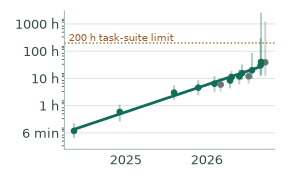
Task horizon
Measured proxy · log scale
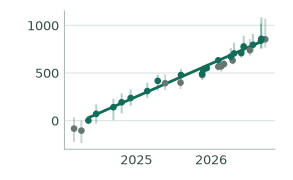
Capability index
Measured proxy · METR points
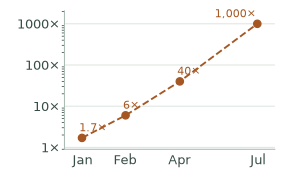
Calendar scenario
Illustrative pace · vs. 2025
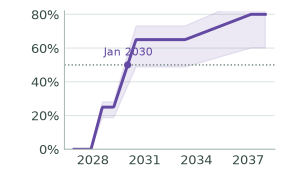
10× research forecast
Subjective chance of verification
Sources and fit checks
Task horizon: constant slope, 3.61 months per doubling. All 15 estimates shown. Held-out errors: 0.24 / 0.43 / 0.42 log₂ minutes over 6 dates (linear / quadratic / hinge).
Capability index: constant slope. All 30 estimates shown. Held-out errors: 20.4 / 37.9 / 41.9 index points over 9 dates in the same model order.
Green dots are publisher-designated frontier; gray dots are other models; bars are reported 95% intervals. Fits use rolling held-out dates from the fixed benchmark cohorts, not live predictions. Related data sets are not independent votes.
Calendar: One conditional AI Futures trajectory, not a fitted forecast. Automated coder: Nov 27, 2026; superhuman AI researcher: Apr 12, 2027; superintelligence: Jul 1, 2027. The dashed line links the slide’s checkpoints, not measurements.
Forecast: January 2030 is the judgment-based median for 10× independently accepted research per elapsed hour, at comparable resources, through two linked gains. Shading varies the assumed 10%–40% stall rate, not statistical confidence. At year-end: 4.1% in 2027, 65.0% in 2030 and 75.4% in 2035. Noncrossing: 20.0%.
- METR Q4: Source estimates by suite (months per doubling): TH1.1 3.07, TH2 (Verifiable) 1.65, MirrorCode 1.79. Published combined estimate 3.61 (95% interval 2.08–4.94). Historical TH1.1 data use a separate cohort.
- METR / OpenAI loss slope (~7×) and METR / Anthropic index slope (1.9×, 95% interval 1.5–2.8×) measure different outcomes. Neither directly estimates throughput. AI Futures partly uses the Anthropic assessment.
- Epoch infrastructure: track permitting, energization, hardware and actual research use separately.
- The Last Boring Slide supplies the pace points. AI Futures supplies the milestone definitions and scenario.
November 28, 2026: forecast rebuilt from scratch
The new subjective median for publicly verified 10× AI research throughput is January 2030, versus February 2031 in the archived forecast. The model assigns 65.0% by the end of 2030 and 20.0% to never crossing. Its middle 50% spans Jul 2028 to Nov 2035. These are scenario judgments, not an empirically fitted prediction interval.
Recency: weight comparable source families by 2−age in days / 7, using original publication dates when experiment dates are unavailable. Count each source family once. The weights are metr-nanogpt: 0.453; firmus-mlperf: 0.336; the resulting fixed-target component proxy is 1.19×. The METR and MLCommons results are not end-to-end research throughput.
Calendar bridge: Project benchmark readiness from the last published comparable task-horizon anchor. Then apply assumed critical-path exposure to the component proxy; count the complete, accepted successor rounds needed to compound to 10×. Target horizons, round lengths, carry-forward, scenario weights and a stalled branch are judgments. The finite scenarios require improvements to carry forward and reach fresh parts of the critical path. If more than 10% of the original elapsed time stays unchanged, no speedup elsewhere can reach 10×. Neither the previous countdown nor AI Futures’ example dates are inputs.
What the previous model missed: Anthropic’s production migration shows why verification can outlast code generation. FrontierRSI tests open-ended tasks, not linked generations. Flex-RSI found bounded harness improvements, and a separate matched successor check did not establish an advantage; math releases test another kind of verifier. The model includes review time and an explicit stalled path rather than treating announcements or paper counts as independent measurements.
Jump to the March 2027 fast path and its checkpoints.
Sensitivity: 3-day half-life → Feb 2030; 28-day half-life → Jan 2030; 25% longer rounds → Sep 2030; 25% less transfer → Jan 2031; Fixed serial bottleneck → no finite median; 40% stall → Oct 2033. No date moves for installed research compute, validated human whole-brain emulation or longevity escape velocity.
How March 2027 could happen
Mar 2, 2027 is the aggressive software-only scenario, not the forecast median. The January 2030 median is not a speed limit. It extrapolates modest component gains; this branch tests a change in how the whole research process works: agents run promising experiments in parallel, while better checks shorten the serial queue of experiment selection, failed-run triage and independent review. Faster generation alone does not deliver that.
- Jan 1, 2027: Start a matched pilot. Freeze a representative research task set and its starting throughput, compute, staffing and acceptance rules. Keep the independent verifier outside the system that proposes the work.
- Jan 31, 2027: Verify the first 3.16×. Count accepted output per elapsed hour including queueing, failures and rework. An internal speedup, more agent hours, or one impressive proof is not this checkpoint.
- Mar 2, 2027: Verify the second 3.16×. Give the successor the first improvement, but use fresh held-out work. It must improve again at comparable resources; the linked gains must total at least 10× against the frozen reference.
What makes the fast path plausible: the independent Lean check shows what a strong verifier can do for one difficult result. Flex-RSI shows that improving the harness can carry into later rounds on bounded tasks. What could break it: Anthropic’s migration shows that verification can become the bottleneck, and a matched AI-research experiment did not establish a successor advantage. These don’t establish either required frontier round. The decisive new signal is the first full-cycle receipt, not a higher benchmark score. If the matched pilot starts later, every date below slips by the same number of days.
How it slips: A 21-day independent-review overrun moves March 2 to Mar 23, 2027. Add a failed 30-day round as well and it moves to Apr 22, 2027. At 2× per round the same start gives May 1, 2027; at 1.5×, Jun 30, 2027. If 5% of baseline elapsed time is permanently untouched, even a 10× overall result requires 19× on the rest; at 8%, it requires 46×. An unchanged share over 10% makes 10× impossible on that workflow.
Separate moonshot: A human emulation by 2030 is an ideal-coordination target, not a consequence of the software clock. It needs whole-person data capture, reconstruction, and independently validated person-specific function. None is dated by this calculation.
Fast RSI, slow light
60 days is a stress test, not a prediction or a physical lower bound. Start the clock at the first comparable research round. Two 30-day rounds, each yielding about 3.16× as much independently accepted work per hour, compound to 10×. At 2× per round it takes four rounds, or 120 days. A successor has to inherit the previous improvement and improve again. Count setup, queueing, failures and review at comparable compute and staffing. None of these round lengths or gains is established at the frontier. The November 28 baseline’s January 2030 median is a separate subjective forecast; the fast case gets no weight in it.
The external AI Futures example on this page gives April 12, 2027 for a superhuman AI researcher and July 1 for superintelligence: 80 days in that scenario. Neither milestone verifies the two-round 10× criterion. Faster software is not faster fabrication, grid connection, clinical validation, or approval. If 20% of a serial workflow cannot be sped up, even eliminating the other 80% caps the speedup at 5×.
What a distant watcher could know
Sagittarius A*, the Milky Way’s central black hole, is about 8 kiloparsecs away. A watcher there sees Earth about 26,000 years in the past; a response to an event here returns about 52,000 years after it. A clock held near the horizon accumulates less local time than a distant clock. Looking out can make distant clocks appear faster; it gives no extra local computing time, and a result cannot escape from inside the horizon. Roughly 7 × 1053 joules is the black hole’s rest energy, not the usable energy of a computer and not a Hamiltonian for an unknown civilization. Horizon physics · Physical limits to computation
Using 1.22 × wavelength × distance ÷ feature size at 550 nanometers, an ideal circular aperture would need to span about 13,000 km to resolve Earth’s disk and 1.7 million km for a 100 km feature. These are diffraction scales, not detection promises. Earth’s reflected light is roughly one ten-billionth of the Sun’s. The world’s 620 exajoules of primary energy use in 2023 averaged about 20 terawatts, around 0.016% of Earth’s natural thermal output. Energy use alone does not tell a watcher what people are doing. Planet imaging · Energy Institute · NASA CERES
The ant and the highway
A speculative extension of the zoo hypothesis is that a civilization could shape another’s incentives instead of supervising it. A center-only watcher is too far away for live steering; a fast intervention would require a nearer mechanism, for which there is no evidence. Silence does not distinguish a dark forest from rare life, weak signals, or an incomplete search. A theory that explains every outcome by hidden design makes no usable prediction. SETI search coverage
The practical lesson doesn’t require aliens. A system need not be hostile to disregard the people in its path. Measure the whole interval from request to verified result, not just time spent generating an answer. Before expanding autonomy, show in a representative drill that affected people can detect a problem, stop in-flight effects before they become irreversible, recover their work, and leave. The test fails if the stop is only acknowledged, not effective. Prefer reversible exploration to irreversible action on a speculative story.
Deep time makes computation and physical resources matter; it doesn’t make simulation free. Rapid software may change what is scarce, but it doesn’t settle who controls chips, power, infrastructure, or the right to say no. There is no date for a change in political economy in this model.